
The Realist Checkpoint
The book came first.
Five parts. Thirty-eight chapters and closing notes. One complete journey from an honest checkpoint to a living system.
The method was on paper before the website or app existed. The complete contents are below so nobody has to buy a cover, trust a back-page promise or guess where Part I is taking them.
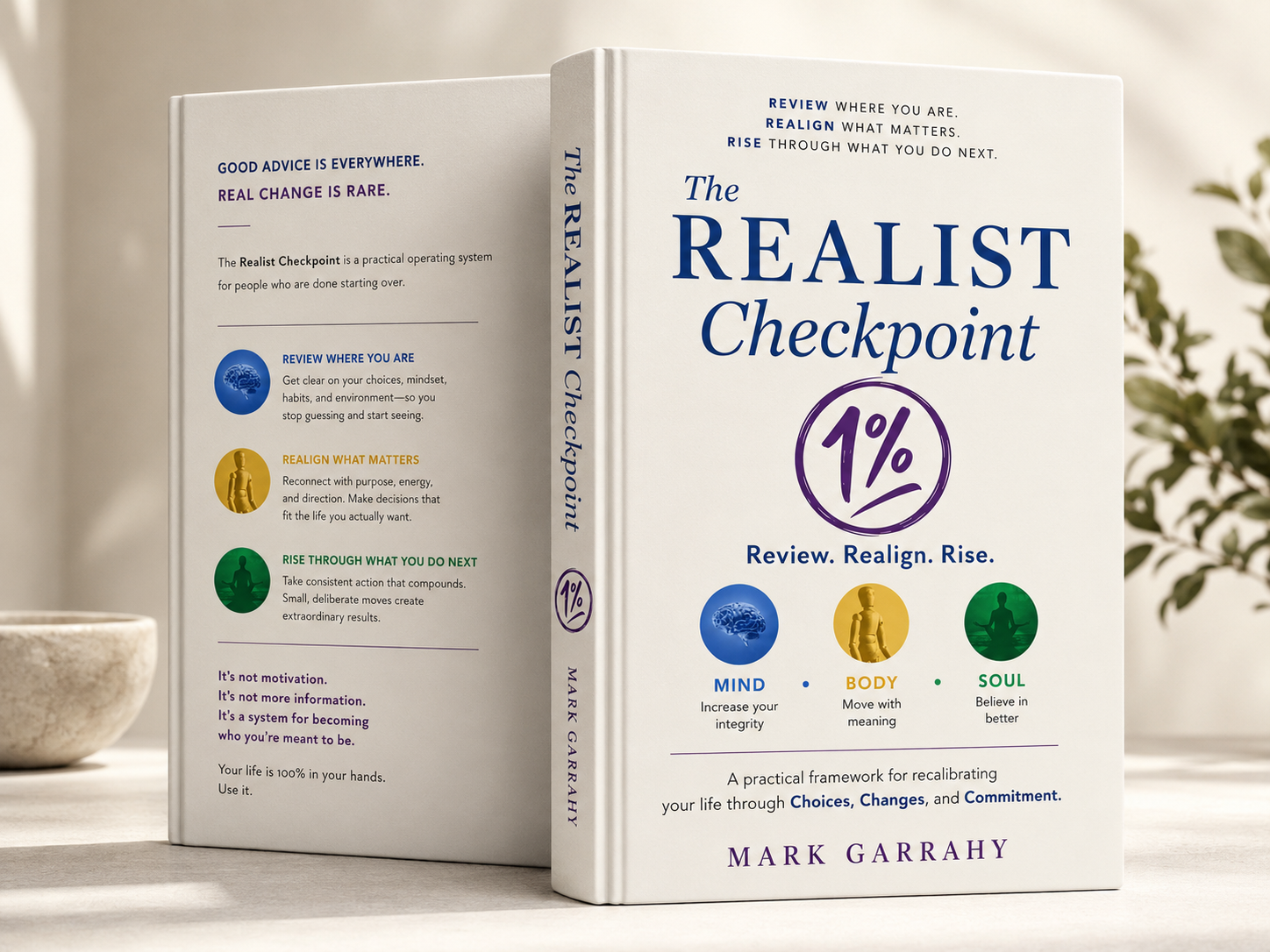
Working cover / concept — not a published edition
PART I — THE WAKE-UP
Read it. Listen to it. Decide after the value.
When you know, you know.
Two things have always bothered me about this category: being asked for an email address before anyone has earned it, and being expected to buy a book on the strength of a cover and the promises written on the back. TRC will not ask you to do either.
Part I will be free to read or hear in full. No form. No subscriber trap. No obligation. If the First Checkpoint and the three directions — Increase your Integrity, Move with Meaning and Believe in Better — sound like goals worth learning a new approach to, The Wake-Up will take you further. If they do not, Part I probably is not worth your time.
THE COMPLETE CONTENTS
See the whole journey before you commit to it.
Every chapter is shown. Press Overview beside any part for the developed journey behind the headings. The contents are not a teaser; they are the actual working structure of the manuscript.
Contents Page
PART I — THE WAKE-UP:
Part I freeOverview
From the manuscript
“You can be respectable and still be drifting.”
Inside this part
The Wake-Up is the honest look before the fixing starts. It begins with the Personal Checkpoint and asks a harder question than “What should I improve?” — what is already happening in my life, and what have I quietly started accepting as normal? From there it examines why more self-help information so often changes very little, then works through perspective, procrastination, cognitive dissonance, mind bias and the Vicious Cycle that can keep capable adults repeating patterns they already know are costing them.
The point is not to convince you that everything is wrong. It is to make drift visible before it needs to become a crisis. By the end of Part I, the distinction becomes important: repeated behaviour can become stubborn, familiar and very convincing without becoming permanent. Hardheaded is not hardwired. That is where the possibility of realignment begins.
- 1.The Personal Checkpoint
- 2.Why Self-Help Fails Without a Checkpoint
- 3.Zoom Out for Perspective
- 4.The Procrastination Trap
- 5.Cognitive Dissonance
- 6.Cognitive Mind Bias and Fallacies
- 7.The Vicious Cycle
- 8.Hardheaded, Not Hardwired
PART II — THE FRAMEWORK:
Overview
From the manuscript
““All right” can hide a lot.”
Inside this part
The Framework gives the self-audit a map. It introduces The Realist Checkpoint properly and builds the TRC Blueprint across Mind, Body and Soul — not as three inspirational categories, but as three dimensions of the life you are actually running. Their Core is Beliefs, Standards and Values. Their Activation Sequence is Choices, Changes and Commitment. Together they provide a way to locate what is helping, what is slipping and what genuinely warrants attention.
This is also where TRC introduces Dimension Measurements and the Needle Position: not a fabricated score, but a way to stop answering the huge foggy question of “How am I doing in life?” with whatever mood happens to be loudest that day. The Part finishes with attention because even the best map is useless if everything else keeps getting first access to your mind.
- 9.The Realist Checkpoint
- 10.The TRC Blueprint — Mind, Body, Soul
- 11.Beliefs, Standards, Values
- 12.Your Dimension Measurements
- 13.The Needle Position
- 14.Choices, Changes, Commitment
- 15.Attention Is A Battlefield
PART III — THE INTERFERENCE:
Overview
From the manuscript
“Most people think the trouble starts later than it does.”
Inside this part
The Interference explains why knowing better so often fails to become living better. It starts earlier than the obvious mistake — at triggers, the first thought, the first negotiation and the moment a better line begins to wobble. From there it separates Dwell in Negative, overkill and overcorrection, then introduces 3×P, 3×N and the Reset Loop as a way to interrupt the pattern before one ordinary wobble earns the keys to the whole week.
The second half looks at where those patterns get tested: pressure points, environment, compatibility, coverage, quick reward, escapology and modern drift. Phones, booze, food, distraction, comfort and endless stimulation are not treated as villains or diagnoses. The question is simpler and more useful: what keeps pulling you off your better setting, and what keeps making the cheaper option look reasonable?
- 16.Triggers Define the Line
- 17.Dwell in Negative
- 18.Overkill Is Overwhelming
- 19.3×P, 3×N, and The Reset Loop
- 20.Pressure Points That Warrant Attention
- 21.The Environment, Compatibility, and Coverage
- 22.Dopamine, Escapology, and the Modern Drift
PART IV — THE RESET:
Overview
From the manuscript
“One per cent of a life. Long enough to stop bluffing.”
Inside this part
The Reset turns understanding into a serious period of lived evidence. The centrepiece is the 300-Day ME Project — 1% of a roughly 30,000-day adult life — long enough to move beyond the usual burst of motivation, short challenge or January declaration. This is where the book shifts from identifying patterns to deliberately testing a better way of living across Mind, Body and Soul.
The chapters deal with the unglamorous mechanics that make change survive ordinary life: the “magic pill” people keep overlooking, staying in the present, building patiently, Reviewing, Realigning and Rising, protecting the build from unnecessary noise and then simply running the course. The goal is not 300 perfect days. It is enough time for the stronger settings to accumulate evidence and stop feeling like a temporary visit.
- 23.The 300-Day ME Project
- 24.The Magic Pill Nobody Wants to Hear About
- 25.The Present Is Unanimously the Winner
- 26.Patiently, Brick by Brick
- 27.Review, Realign, Rise
- 28.Work in Secrecy / Protect the Build
- 29.Run the Course
PART V — THE LIVING SYSTEM:
Overview
From the manuscript
“Beliefs are supposed to mature as the person does.”
Inside this part
The Living System asks the question most short challenges never reach: what happens when the reset is over? Part V returns to the Core and deliberately upgrades Beliefs, Standards and Values so the better state is no longer something you visit when motivation is high. It then moves toward Life on an Even Keel — less boom-and-bust, less unnecessary recovery from your own choices and a stronger default across the way you think, act and feel.
The final chapters put information back in its proper place, run the Shawshank Settings Test on whether the better life has become genuinely familiar, and finish with Save Your New Settings. The ambition is not perfection or permanent blue skies. It is a life whose stronger settings have become valuable enough that you stop casually selling them back for the old ones.
- 30.Upgrade Your Beliefs
- 31.Upgrade Your Standards
- 32.Upgrade Your Values
- 33.Life on an Even Keel
- 34.Information Is Cheap and Talk Is Gibber
- 35.The Shawshank Settings Test
- 36.Save Your New Settings
CLOSING NOTES:
Overview
From the manuscript
“The next part is not printed here. It is lived.”
Inside this part
The Closing Notes deliberately stop adding machinery. By this point the Checkpoint, Blueprint, Interference, Reset and Living System have all been laid out. Before You Close the Book asks what kind of reader all that information has produced, and 30 Words. None of Them Work If You Don’t strips the entire exercise back to the uncomfortable final truth: language only matters when it survives contact with an ordinary day.
The book can help you locate the gap, understand it and build a way through it. It cannot live the next part for you.
- 37.Before You Close the Book
- 38.30 Words. None of Them Work If You Don’t